DIY Standing Station

standing station

I’ve never sat so much in my life.

Don’t get me wrong: I like my job. Balancing marketing communications, grant writing, event planning, vendor contracts and whatever else comes along keeps me jumping mentally. But physically? Not so much.

I just don’t get out and about like I did when I was a newspaper reporter. Even when I do, it’s typically to get into my car – where of course I sit – and go somewhere for a meeting to sit some more. I do try to take a walk at lunchtime, even for half an hour, and am active on the weekends and most evenings. I just needed more.

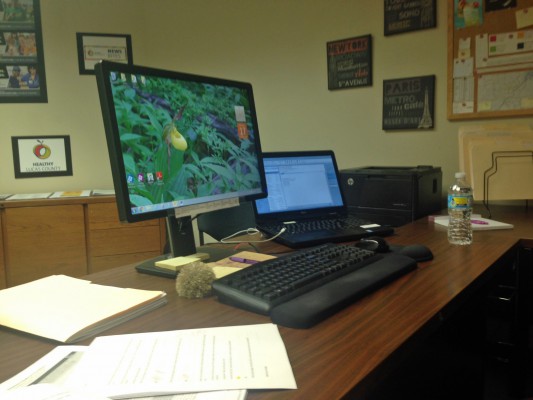
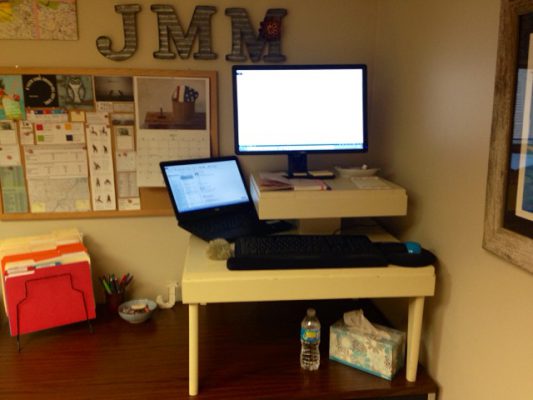
A sit-stand station on top of my desk for my computer setup seemed like a good way to stay off my burgeoning tush, at least for a few hours a day. I could raise a sit-stand station when I wanted to stand and lower it when I didn’t. I had a few considerations, though:

  • I use two monitors, so I needed a bigger and sturdier model.
  • I’m nearly 6-foot tall in bare feet. So I also needed a model that would accommodate a taller person, especially one who often wears a bit of a heel and wants to stand on a cushy mat.
  • I really did not want to spend $500 or so to meet the above requirements.

Instead, I decided to try my luck with repurposing a two-tier end table or other piece of small furniture. I ran into several possibilities while shopping at a consignment store with a friend, and the clerk pointed out one that turned out to be nearly ideal. It certainly helps that my office had two hefty desks that I pushed together into an “L” shape – I work at a true nonprofit, where we make due with donated furniture – and both are 30” deep. When I want to sit, I just move my laptop to the other desk.

How many calories am I burning by standing instead of sitting? A little more than 50 calories an hour, according to this calculator from Ergotron, Inc. That’s not much, but it will add up, and it certainly feels good to stand at times.

And while my standing station is not nearly as nice as Ergotron and other companies make, it definitely works for me.

Exploring Pokagon

single lady slipper

This gorgeous yellow lady slipper wild orchid was just off the boardwalk near Lake Lonidaw.

There is so much more to Indiana’s Pokagon State Park than swimming, camping, biking and horseback riding.

Don’t get me wrong, all of those activities are great. In the winter, Pokagon visitors also can toboggan and cross country ski. But Pokagon’s often overlooked stars are the nearly 14 miles of hiking trails – and an array of wildflowers, ferns, grasses, forests, hills, wetlands and meadows.

Pokagon is located on Lake James near Angola, Indiana. I hiked and camped there often in the mid 1990s when living in Fort Wayne and have rediscovered its varied, natural charms in recent years.

The trails are all easy to navigate, although some are more rugged than others. Those on the park’s the eastern side, including trails in Potawatomi Nature Preserve, are the most picturesque and serene. There also is a connector off trail eight to Beechwood Nature Preserve, which offers a lovely 1.5-mile meadow loop.

Pokagon trail seven loop overlook

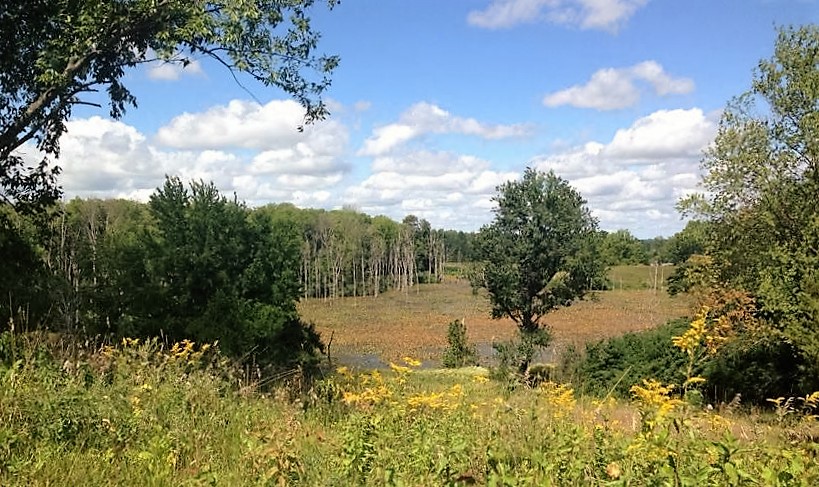
The view of wetlands from trail seven.

Pokagon’s rolling terrain was created by a glacier, and Hell’s Point on trail three is a high point, both figuratively and literally. Hell’s Point is a kame, a sharply crested hill resembling a rooster’s comb and formed by debris as the glacier melted.

The southern side of trail seven’s loop offers another favorite view, this one of wetlands. The trail seven loop itself is especially gorgeous in summer, when New York ironweed and other prairie flowers are in their glory.

Go to Pokagon for the beaches in the summer, the toboggan run in the winter or lake views all year long. Just don’t forget the hiking trails, too.

Details, details

image

I attribute my keen attention to detail – when, and only when, I choose to use it – to an early Catholic school upbringing. Nuns, after all, were not fond of children who didn’t follow instructions.

I started going to public school in fifth grade, and it soon became clear that my background was an asset. The teacher gave us a quiz and told us to read all of the questions before answering any. I read the entire quiz while my classmates scribbled answers, barked like dogs and raced through other questions. The last entry said to put down my pencil and wait for everyone else to finish. Eventually, my classmates realized why the strange new kid was just sitting there and grinning, and they followed the directions as well.

My fastidiousness for directions still is coming into play decades later. Most recently, it appears to be one of the reasons my boss asked me to help with grant writing. Our nonprofit organization doesn’t have a dedicated grant writer, so she decided to have me pitch in and give it a whirl. I think it helps that I believe deadlines are just that, not mere suggestions. After all, meeting application deadlines appears to be as critical to the grant-writing process as following directions.

I started out in late 2015 by applying for two awards with monetary prizes before moving on to small grants. Less than six months into this added role, I’m working on a multi-million dollar opportunity. Some of what I’ve learned so far:

  • Patience also is a must, especially when it feels like you’re herding cats to get feedback.
  • Word or character counts can be tight, so answers must be brief but thorough.
  • Seeing that screen saying your application is received when you’re all through is quite a relief.

If any grant writers have some advice, I’d love to hear it.